
T-Mobile Keeps Its 5G Standalone Crown, and It’s Not Even Close
AT&T and Verizon may have nationwide 5G standalone networks now, but when it comes to actually putting customers on them, T-Mobile is still lapping the field.
Fresh Opensignal data, reported by Android Authority, shows T-Mobile customers were connected to 5G standalone 71.2% of the time. Verizon came in at 20.2%, and AT&T managed just 4.4%. In other words, the average T-Mobile customer spends more than three times as much time on SA as a Verizon customer and roughly 16 times as much as an AT&T customer. T-Mobile also took the latency crown at 40.2 milliseconds, just ahead of AT&T at 40.6 and Verizon at 42.9.
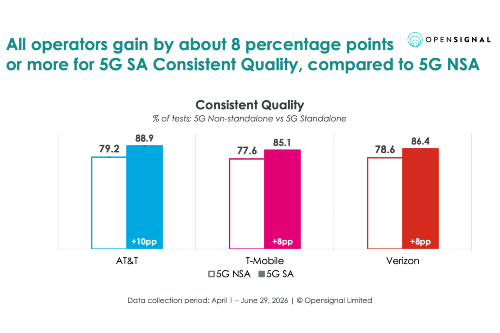
To be fair to the competition, AT&T had some wins of its own. It posted the fastest 5G SA speeds, at 344.7 Mbps down and 22.6 Mbps up, though Opensignal notes its lightly used SA network may be helping there. AT&T also led in Consistent Quality at 88.9%, with Verizon at 86.4% and T-Mobile at 85.1%. That consistency number is one T-Mobile will want to work on.
T-Mobile’s lead comes from years of head start. It started rolling out 5G SA in 2019 and went nationwide in April 2025, while AT&T only flipped the switch on its nationwide SA network last October. That head start keeps showing up in third-party rankings, including J.D. Power, as we covered when T-Mobile won big with small businesses and enterprises in J.D. Power’s latest rankings.
Why does SA matter? It’s the foundation for lower latency and features like the network slicing behind T-Priority and other 5G Advanced services, so a big SA lead means T-Mobile can roll out new capabilities to more of us, faster. AT&T’s speed numbers show it shouldn’t be counted out, but for now, Magenta’s standalone advantage is about as clear-cut as these reports get.
Source: Android Authority