


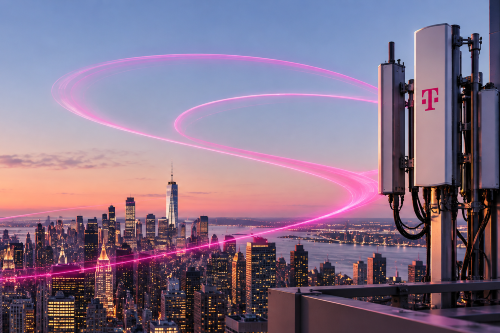
T-Mobile keeps talking up AI in its network, and now it has some fresh numbers to back that up. The Un-carrier says letting AI manage how its 5G Advanced network directs signals is already paying off for customers in New York City.
In an announcement, T-Mobile detailed results from AI-driven beamforming work with Ericsson at newly activated sites in New York City. Beamforming is how cell sites focus signals toward your phone instead of broadcasting them in every direction.
The biggest gains showed up during peak hours, when the network is busiest: roughly a 50% increase in advanced beamforming using full-band sounding reference signals, a 16% improvement in download speeds for users, 12% better spectral efficiency, and a 10% jump in the amount of downlink data the network carried.
There’s a caveat worth mentioning. T-Mobile didn’t say how many sites were part of the work or what baseline it measured against, so these are company-reported numbers rather than independent test results. Still, they’re in line with an earlier T-Mobile and Ericsson trial of an AI-native scheduler, which reported close to 10% better spectral efficiency and up to 15% higher download speeds on live customer traffic.
This is just the latest example of T-Mobile leaning into AI to squeeze more out of its existing spectrum. Earlier this year, the carrier also detailed how AI was helping its network adapt during storms and outages, as we covered when T-Mobile said AI is already helping its network handle real-world problems.
For those of us using T-Mobile in crowded places like Manhattan, smarter beamforming could mean fewer slowdowns at rush hour and during big events. The real test will be whether these gains hold up as T-Mobile expands the tech beyond NYC, so here’s hoping the next update comes with some nationwide numbers.