


A former New York police and fire chief is now working inside T-Mobile to make sure emergency workers have the connectivity they need when disaster strikes. Brian Gould, who led rescue operations during a devastating 2022 blizzard in Western New York, has brought his three decades of firsthand emergency experience to the company as an Industry Segment Advisor focused on public safety.
According to T-Mobile’s announcement, Gould’s transition from the field to a corporate role was driven by a specific realization: during the December 2022 Buffalo-area blizzard, communication systems failed his team when they needed them most.
Dozens of agencies were trying to coordinate rescue operations, but strained networks made it nearly impossible to keep everyone on the same page. Police vehicles became stranded, power outages left residents without heat, and 911 dispatchers heard calls of people having medical emergencies they couldn’t reach in time.
“I remember sitting in the command center, hearing 911 calls of people having medical emergencies in their vehicles, knowing that if we didn’t get there, that person was likely going to die,” Gould recalled. That experience shaped what he does now: ensuring first responders have the technology to do their jobs during the worst moments.
Today, Gould is part of a team of nearly 50 retired police officers at T-Mobile who collectively bring almost 1,400 years of emergency response experience to the company. They advise T-Mobile on how to build networks that won’t fail when communities need them most.
T-Mobile’s answer includes three main technologies. T-Priority gives first responders dedicated access to 5G networks, meaning their calls, messages, and emergency communications get through even when regular networks are overwhelmed. T-Satellite is the company’s direct-to-satellite service, allowing emergency texting and data in areas with no cell coverage—a feature that’s already being used by more than 650 satellites orbiting the United States.
Self-Organizing Network, or SON, uses artificial intelligence to automatically adjust antennas and reroute signals around damaged infrastructure without human intervention.
“It’s not just about how we show up in the events,” Gould explains, “but also on our blue-sky days, when nothing is happening, the real work begins to make sure first responders understand what’s available before they ever even need it.”
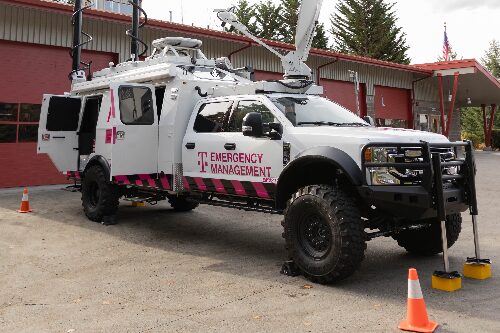
The company also deploys specialized trucks called SatCOWs and SatCOLTs, along with drones, to provide temporary coverage when infrastructure is damaged or overwhelmed. These tools worked together recently as T-Mobile prepared for winter storm Fern, which impacted millions across 34 states in January 2026.
What makes Gould’s role unique is that he’s still an active volunteer firefighter in his spare time. He knows what first responders actually need because he still answers emergency calls. That perspective helps T-Mobile bridge the gap between corporate technology and real-world emergency response. As he puts it: “T-Mobile saw the future and built for it.”